


FEMSA’s proximity division, OXXO, closed 2023 with sales surpassing $278 billion MXN, accounting for more than 39% of the company’s total revenues.
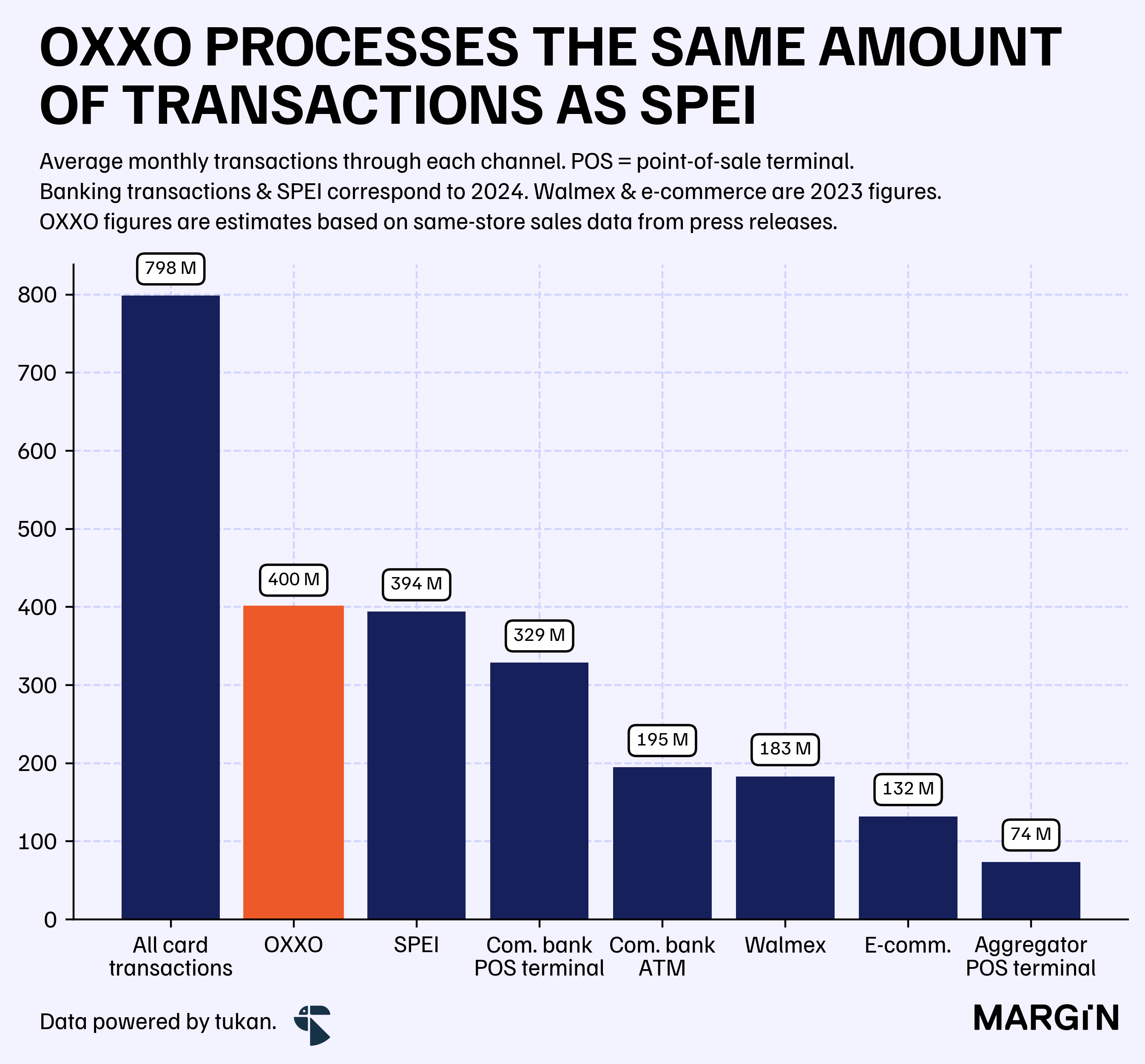
During the past 10 years, OXXO’s footprint across Mexican soil has grown from 12,200 stores to more than 23,600 as of June this year. In the process, FEMSA has now built a massively strong network of stores that could be processing over 400 million transactions each month1.
To give some context on how impressive this figure is, the whole SPEI system averaged close to 400 million transactions each month during the first three quarters of this year.
Plus, this figure would be more than double than the total amount of ATM transactions across all commercial banks in the country.
OXXO’s relevance as a business unit for FEMSA and as a household name for Mexicans is unquestionable, with its stores covering nearly every corner of the national territory.
For today’s Margin article we decided to dive deep into OXXO’s geographic footprint across Mexico. How much population is covered by the network? How close are OXXOs from each other? And, where could there be room for growth?
According to data from OXXO’s website, seven states in Mexico have more than 1,000 stores from the retail giant, and none have fewer than 140 stores. For context, Círculo K, one of the main competitors, closed 2023 with 1,156 stores across the entire country.
Based on our estimates using each store’s location data, we found that 5% of OXXOs in the country have at least one other store within a 250-meter radius. This percentage increases to 23% when the radius is expanded to 500 meters, and nearly 62% when extended to a full kilometer.
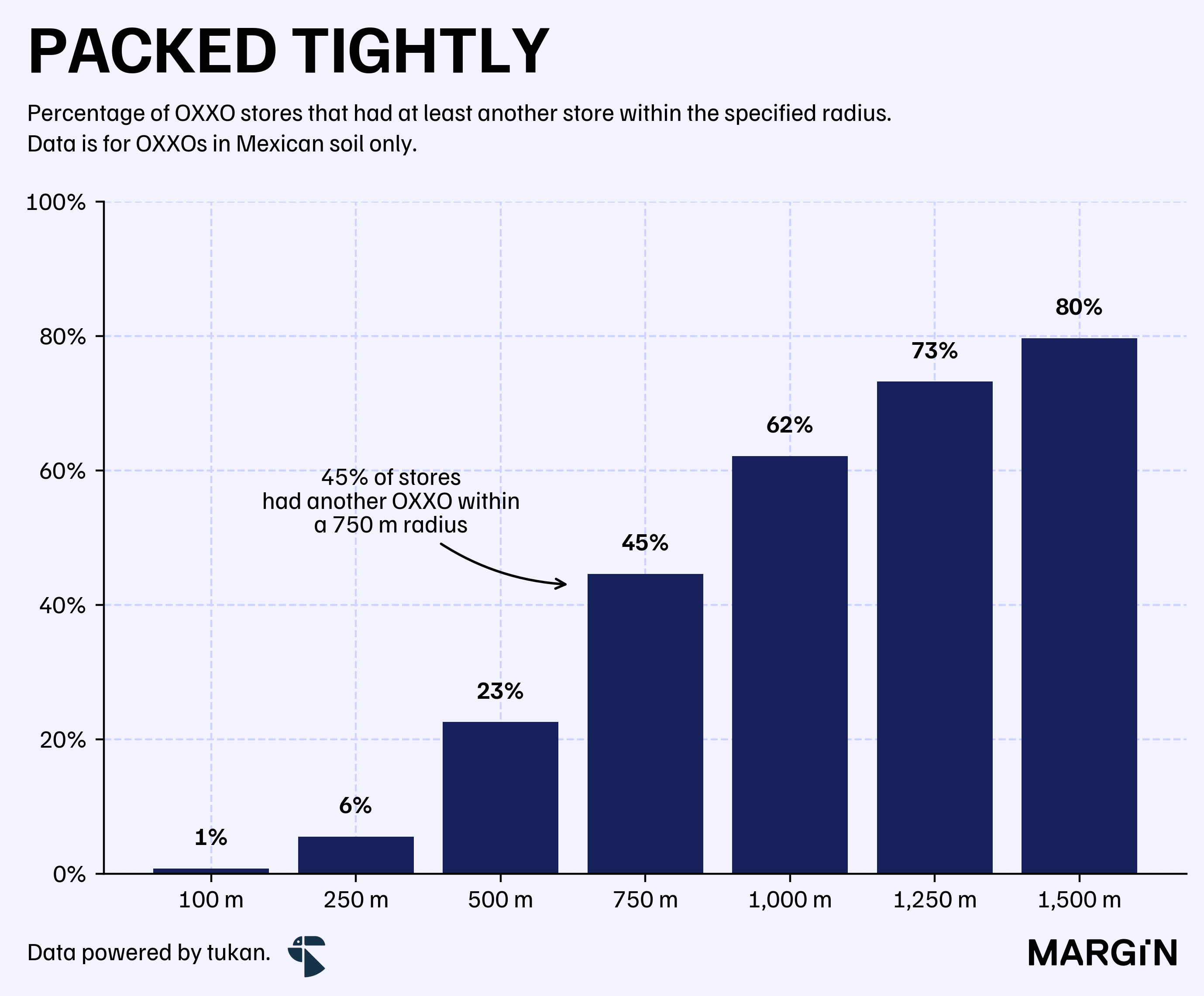
This illustrates the impressive ability of FEMSA’s retail division to establish stores in close proximity to one another, demonstrating that even with more than 23,000 stores, there is still ample room to build additional locations across the country.
For example, take a look at this area in Tijuana, Baja California. According to OXXO’s website and Google Maps, this cluster of stores near the San Ysidro border crossing features nearly a dozen shops within a 500-meter radius.
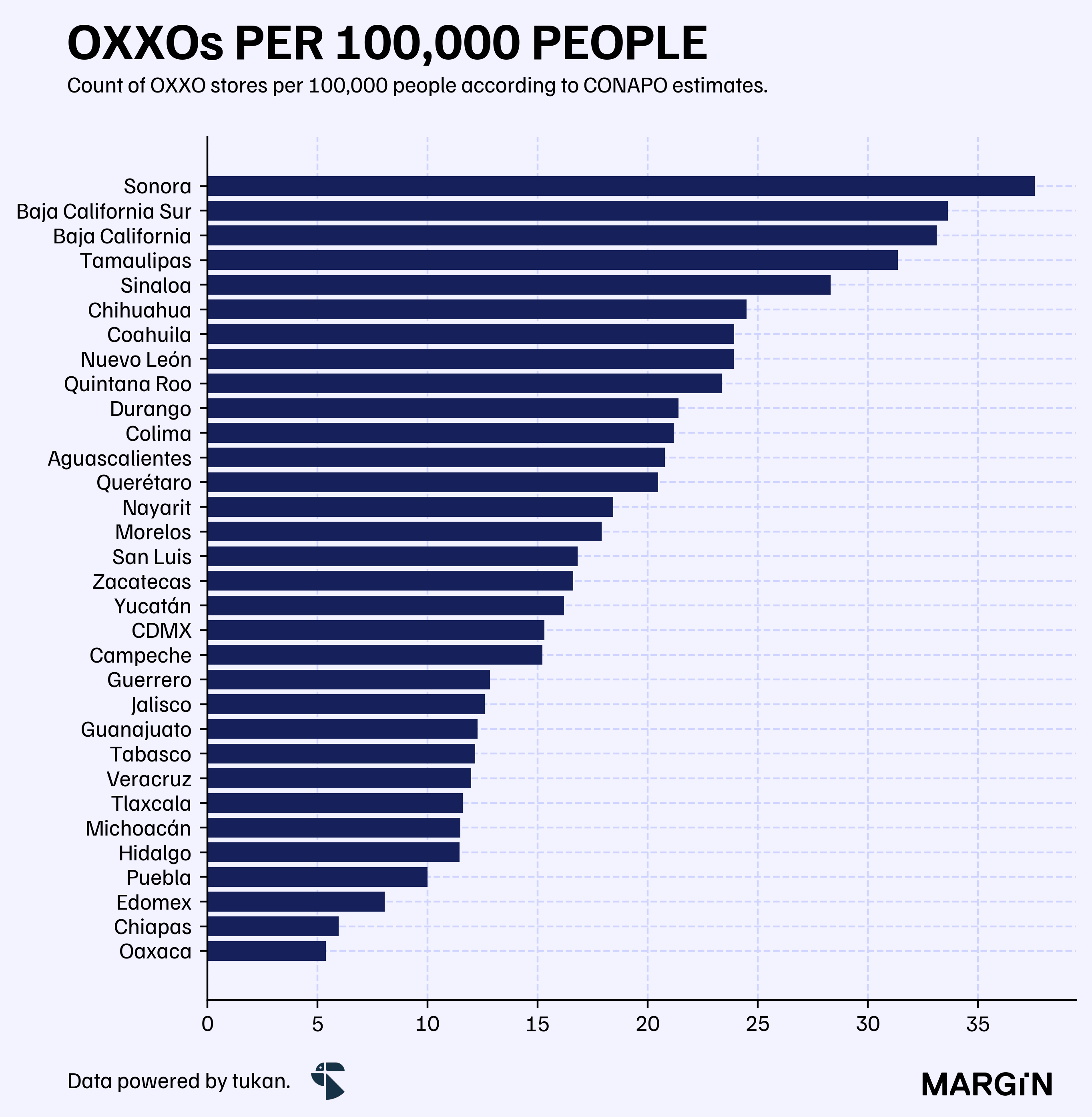
To give a sense of the density behind the store’s network, consider that there are 48 commercial bank ATMs per 100,000 people in Mexico — for OXXOs, the figure sits at 16 per 100,000 inhabitants. A ratio quite imposing, considering the benchmark we’ve provided.
Additionally, when examining the company's footprint in terms of each state’s population, only three states—Oaxaca, Chiapas, and Estado de México—have fewer than 10 stores per 100,000 inhabitants.
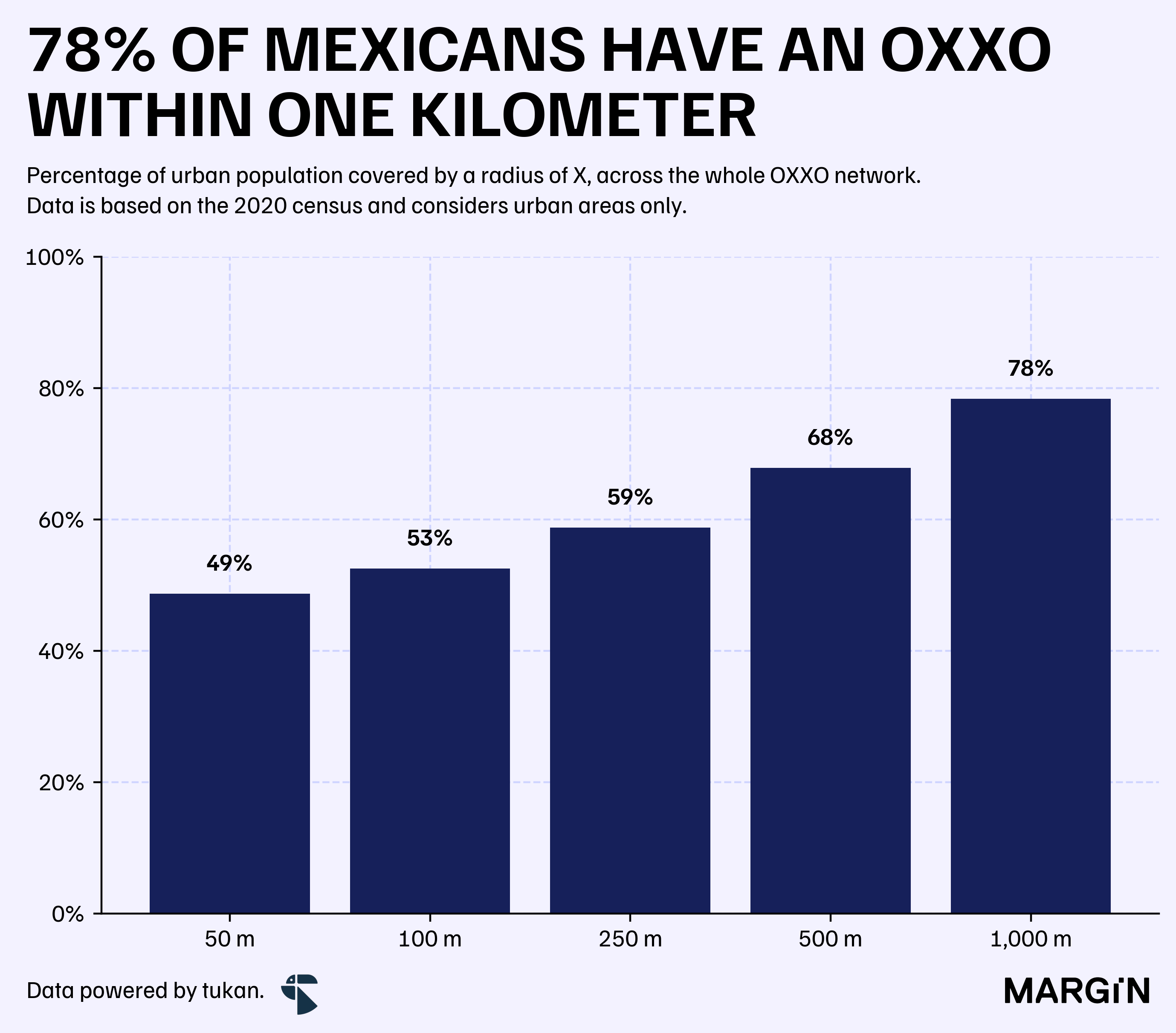
Such is the power of OXXO’s geographical footprint that we estimate that more than half of the Mexican population living in urban areas had an OXXO store within a 100 meter radius.
At a state level, the figures become even more surprising with states such as: Baja California and Sonora having coverage of over 75% within just a 100 meter radius of the stores.
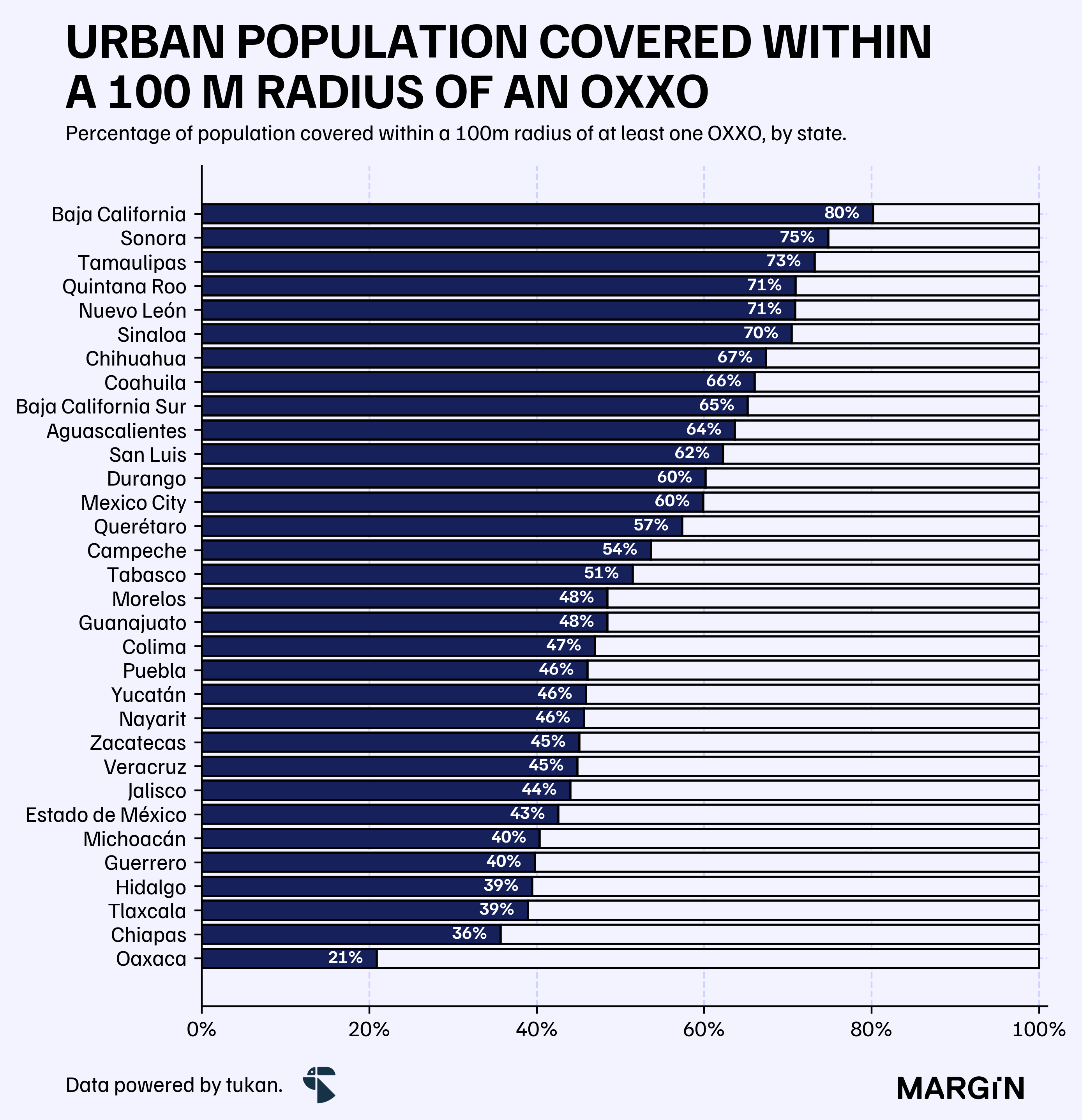
When we visualize the numbers behind the network built by FEMSA over the span of 45 years, it’s clear why the company is aiming to invest heavily in its financial services division and enhance its importance as a correspondent for financial institutions across the country.
It would be hard to find another company in the country with such a strong arm to cover 70% of the population within a 500 meter radius. To put this figure into context, the CNBV’s latest financial inclusion report presented that 75% of the population would have a financial institution’s branch within a 2 kilometer radius — that is, considering commercial & development banks, SOFIPOs, SOCAPs, etc.
As FEMSA continues to expand its influence through OXXO’s extensive network and its growing financial services division, the company is well-positioned to have an important role in such a competitive industry. In particular, this could be a player that truly bridges the gap between the underserved population and financial inclusion.
Will FEMSA’s efforts and geographic footprint redefine how financial services are accessed across the country?
Based on the same store sale data from the 2Q24 press release which showcased an average of 18,000 transactions per store.
Hola
Me pueden explicar el dato de que Oxxo procesa 400 millones de transacciones al mes? No lo veo posible, si tienen 23,600 tiendas en méxico. Necesitaría cada tienda hacer 16,950 transacciones al mes, eso viene siendo al día 564 transacciones, no hay manera de que ese dato esté correcto. Considera que en las noches casi no hay gente en los oxxos y operas solo de día