



Investment
During October, investment in fixed assets remained virtually flat on a sequential basis but registered a 4.5% annual decline, according to seasonally adjusted figures.
INEGI data shows that most of the decline in the country’s investment was due to strong contractions in construction (-12% YoY). On the flip side, investment in imported machinery and equipment hit record highs, rising 4.3% YoY.
Despite the contraction at the end of this year, since 2022, the upward trend in INEGI’s Fixed Capital Formation Index has been remarkable. This index essentially tracks the behavior of the public and private sectors in purchasing fixed assets, such as construction, machinery, and equipment.

Consumption
On the consumer side, we are beginning to see signs of weakening consumption patterns among Mexican households. The country’s consumption index dipped 0.7% sequentially in October, based on seasonally adjusted figures.
On a 12-month rolling basis, consumption grew by 3.6% YoY, with imported goods and services accounting for most of the growth, rising an impressive 17% YoY.
Since the end of 2023, the consumption of imported goods in Mexico has consistently delivered double-digit annual growth rates.
Banks
The commercial banking sector's loan portfolio surged to $7.6 trillion pesos in 2024, representing an 11.5% year-over-year (YoY) increase. Delinquency rates (NPL-adjusted ratios) remained stable at 4.2%, up slightly by 10 basis points (bps) YoY.
Despite the sector’s overall stability, some banks experienced significant increases in their NPL-adjusted ratios: Invex (+259 bps), Intercam (+134 bps), and Covalto (+105 bps).
The industry’s consumer loan portfolio grew by an impressive 17.7% YoY, with strong performance across key segments:
Credit cards: +13.0% YoY
Personal loans: +14.1% YoY
Auto loans: +28% YoY (excluding Inbursa)1
Payroll loans: +9.1% YoY
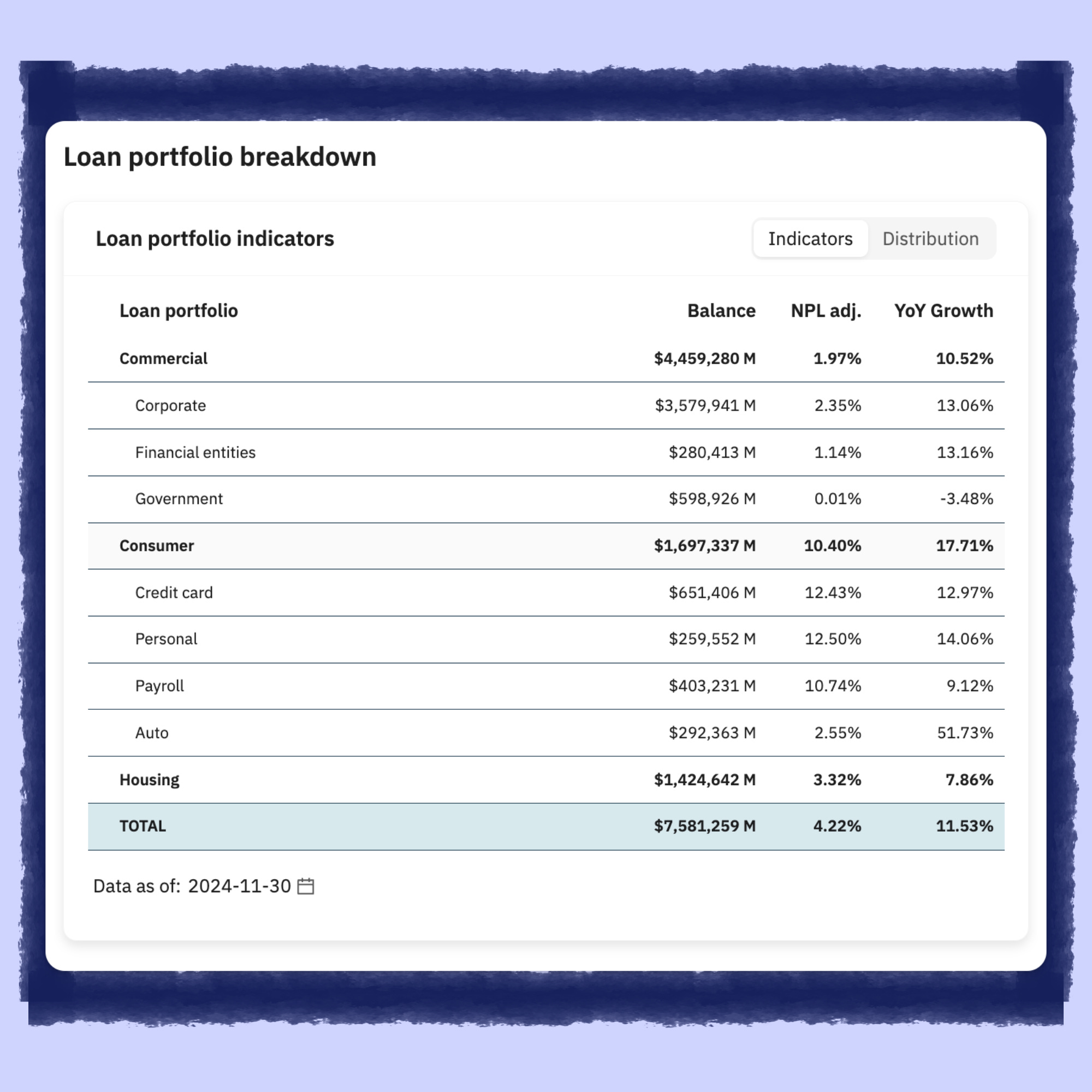
On the other end, commercial loans came in at +10.5% YoY, with most of the country’s major players posting impressive growth rates.
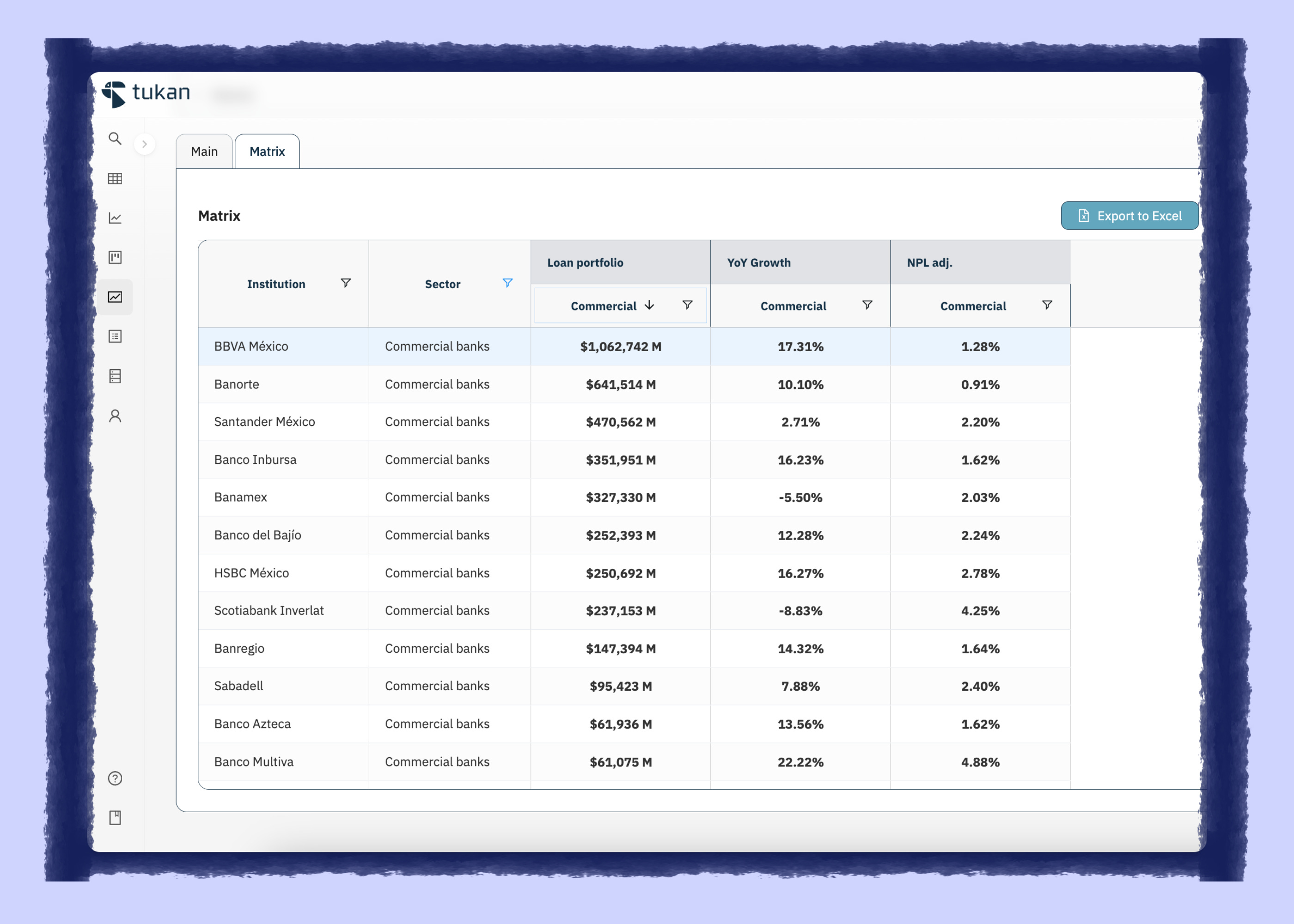
For a full dynamic picture of the banking system’s performance, we recommend you subscribe to tukan’s Financial Institutions Report: a dashboard focused on delivering insight into banks, SOFIPOs and SOCAPs operating in Mexico.
Try your first six months at a 50% discount, an offer exclusive to Margin subscribers — just type the code MARGINKPIS at checkout.
If you have any questions feel free to reach out to me at miguel@tukanmx.com.
SOFIPOs
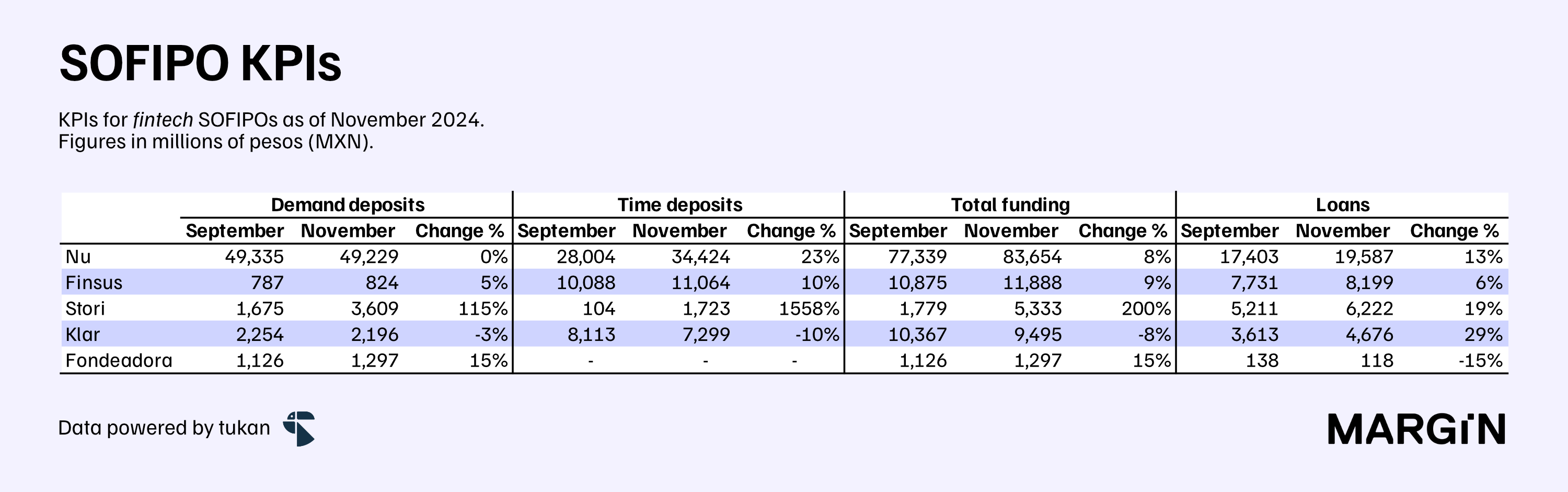
Total funding for Nu, Klar, Stori, Finsus and Fondeadora reached close to $112 billion pesos at the end of November — up 6.2% from October’s numbers.
For reference, BanCoppel’s total funding would be of about $139 billion pesos.
Since September, most of these fintechs have been experiencing some slight deceleration on their funding growth rates. However, term deposits are growing at a better pace than demand deposits, an effect likely due to the slash in yields for demand deposit accounts.
Loan portfolios, on the other hand, showed an important improvement when compared to September figures.
Mobile banking
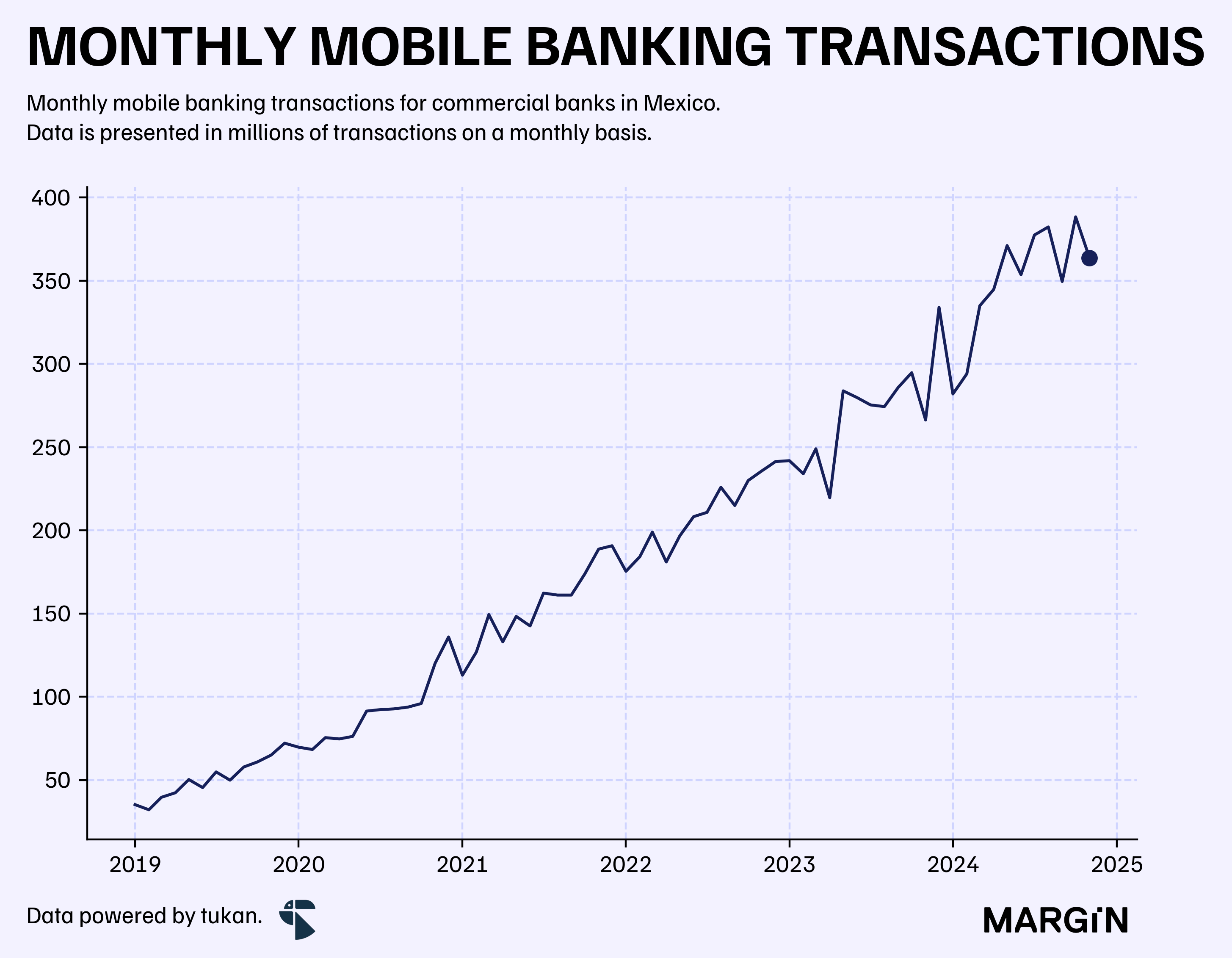
During the first 11 months of 2024, mobile banking transactions increased by more than 32% YoY according to CNBV data.
The regulator’s data showed that between January and November of 2024, commercial banks processed more than 3.8 billion mobile transactions for more than 34 million customers (or accounts), averaging close to 10 transactions per month per customer.
In case you missed it, we recently did a deep dive on SPEI’s explosive growth.
Manufacturing
Manufacturing production continued its growth trend during November, with a 1.1% MoM increase in production volumes and a 2% YoY growth.
Key contributors to this growth were chemical product manufacturing (resins, in particular), iron and steel products, and textiles. All of which have consistently boosted production volumes when compared to last year.
Tourism
According to SECTUR data, hotel occupancy in Mexico remained stable throughout 2024, closing the month of November with an overall occupancy rate of 59.3% across 70 touristic destinations.
Beach destinations registered an aggregate occupancy rate of 65.5% during the first 11 months of the year; with Playacar in Quintana Roo boasting the highest occupancy rate across the country at 87.2%. Excluding Acapulco, the two destinations that saw the biggest dips in occupancy rates were: La Paz (-3.7 percentage points) and Mazatlán (-3.4 points).
Pension funds
Mexican Afores closed 2024 with more than $6.8 trillion in net assets, a figure 14% higher than during 2023.
Profuturo, a company that would’ve ranked as the 4th largest pension fund in the country in 2018, is now the market’s second largest player and sits just 2.6% behind Banorte’s Siglo XXI — the company also delivered the best 12-month returns on 5 out of the 10 SIEFOREs2, particularly outperforming on the funds tailored to the younger workforce.
If you’re interested on learning how pension funds make money, we did an intro on this a while back.
We exclude Inbursa due to the Cetelem acquisition at the end of March of last year.
SIEFOREs are the specialized investment funds managed by the Afores. Each SIEFORE is tailored to specific age groups, balancing risk and return based on how close a person is to retirement—more aggressive for younger workers and more conservative for older ones.